Eco-Tech
Two recent projects show the expansion of solar energy in the Pittsburgh region
By Amanda Waltz
September 29, 2020
Hazelwood Green was once home to the LTV Hazelwood steel facility. When the mill closed in 1998, the 178-acre area was designated as a contaminated brownfield site, affected by years of industrial pollution.
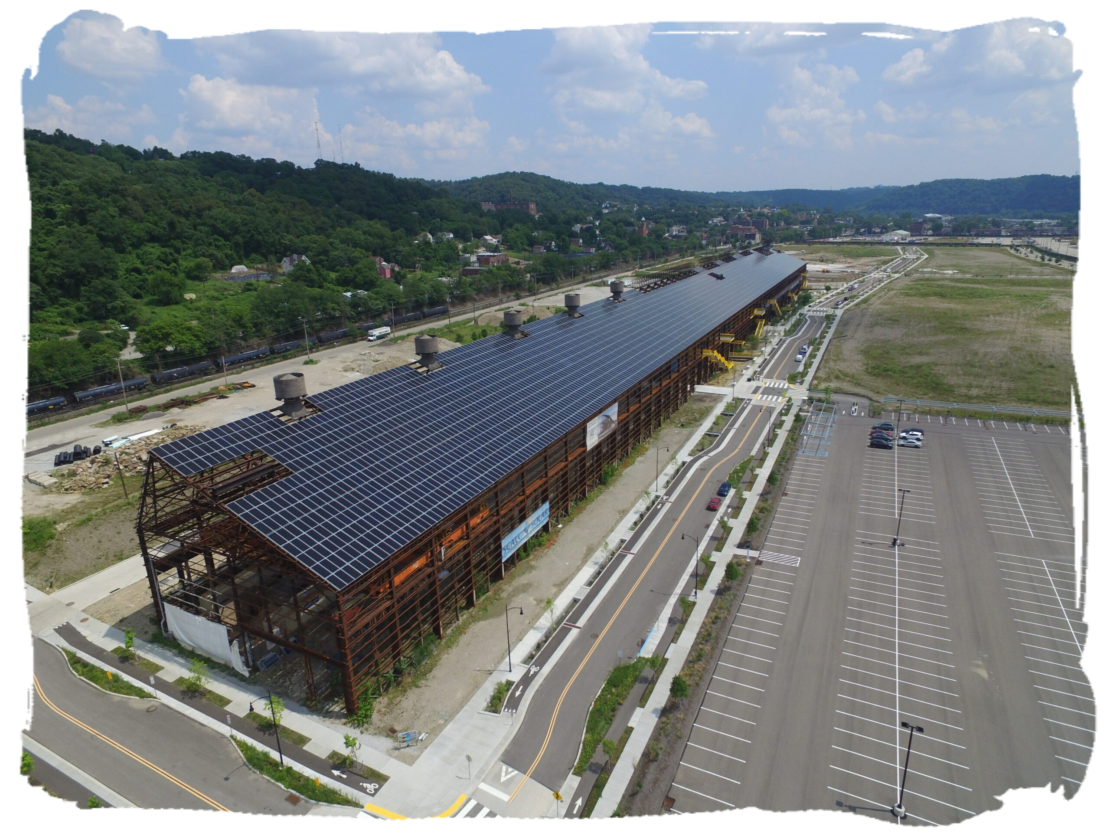
But now, Hazelwood Green, which is being converted into a mixed-use riverfront space to house tech companies, nonprofits, and more, has the largest solar array of its kind on the country installed on its Mill 19 building.
Completed in late August, the array spans the Mill 19 roof at 133,000-square-feet, making it the largest single sloped-array in the United States.
Michael Carnahan, vice president and general manager of Scalo Solar Solutions, the Pittsburgh-based company that installed the array, claims the array will generate about 2 megawatts (mW) of power. He adds that, over its lifetime, the array is expected to produce enough energy to power the equivalent of 264 homes annually, and prevent the release of CO2 emissions equal to 62.5 million pounds of coal being burned.
The array, which cost around $5 million, was made possible by a low-interest loan from the Richard K Mellon Foundation.
Carnahan believes the project will demonstrate the value of investing in solar power, and possibly help it expand in the region, which has been slow to adopt wide-scale renewable energy technology.
“Believing that solar energy needs to be cheaper than heavily subsidized and greenhouse gas causing fossil fuels is part of the education problem we face in trying to promote clean energy,” says Carnahan.
The array is not only environmentally friendly, but economical, with Carnahan pointing out that, with the energy-cost savings, the array should “pay for itself in about 7 years and will last for about 25 years.”
The Mill 19 array is not the only large-scale solar project unveiled this year in the region. On August 27, a 10,000-square-foot array solar array installed by Scalo Solar Solutions on the roof of Global Links headquarters went live.
The array was meant to mark the 30th anniversary of Global Links, a Pittsburgh-based nonprofit that rescues surplus medical supplies and distributes them to needful public health facilities locally and around the world.
Made from a total of 162 bi-facial solar panels, the full array is expected to generate 63.2 kilowatt (kW), equal to 82 percent of the energy currently being used by the Global Links offices and warehouse.
"For 30 years, Global Links has helped healthcare institutions, businesses, and the community reduce their environmental impact through the donation of surplus and no longer needed medical supplies, home healthcare supplies, and office equipment,” says Angela Garcia, executive director of Global Links. “We seek every opportunity to minimize the environmental impact of our own operations, and our conversion to solar not only serves our energy needs, but will serve as a model for inspiring further green energy development in our region.”
The array is the first cohort project of the Pennsylvania Solar Center, an organization dedicated to transforming Pennsylvania into a leading solar state. It was made possible through financing offered by Scalo, and through a $150,000 grant from the Green Mountain Energy Sun Club, a nonprofit initiative that focused on projects related to renewable and efficient energy, resource conservation, and environmental stewardship.
A press release claims that, since being founded in 2002, the Sun Club has donated $10 million to more than 122 projects across Texas and the Northeast.
Mark Parsons, vice president and general manager for Green Mountain Energy, says Sun Club understands how “instrumental nonprofit organizations are to the well-being of communities,” and that Global Links demonstrates how that extends to using clean energy.
“We commend Global Links for their model of medical surplus recovery and donation to underserved communities, as it places equal emphasis on supporting health improvement initiatives while promoting environmentally sustainable practices in healthcare and beyond,” says Parsons.
When it comes to the nonprofit and private sectors, the expansion of solar power in the region, it seems, is expected to continue. Carnahan says all 178 acres of Hazelwood Green is “meant to be developed with renewable energy and sustainability as part of its core design,” and that there are already plans add another 1,100 solar panels in the two parking lots on the site and on the Plaza, a public park that will be open next spring.
Amanda Waltz
Amanda Waltz is a regular columnist with The Green Voice Weekly Newsletter